English (UK)
  日本語 (Japan)
  한국어 (Korean)
  Tiếng Việt
  中文 (Chinese)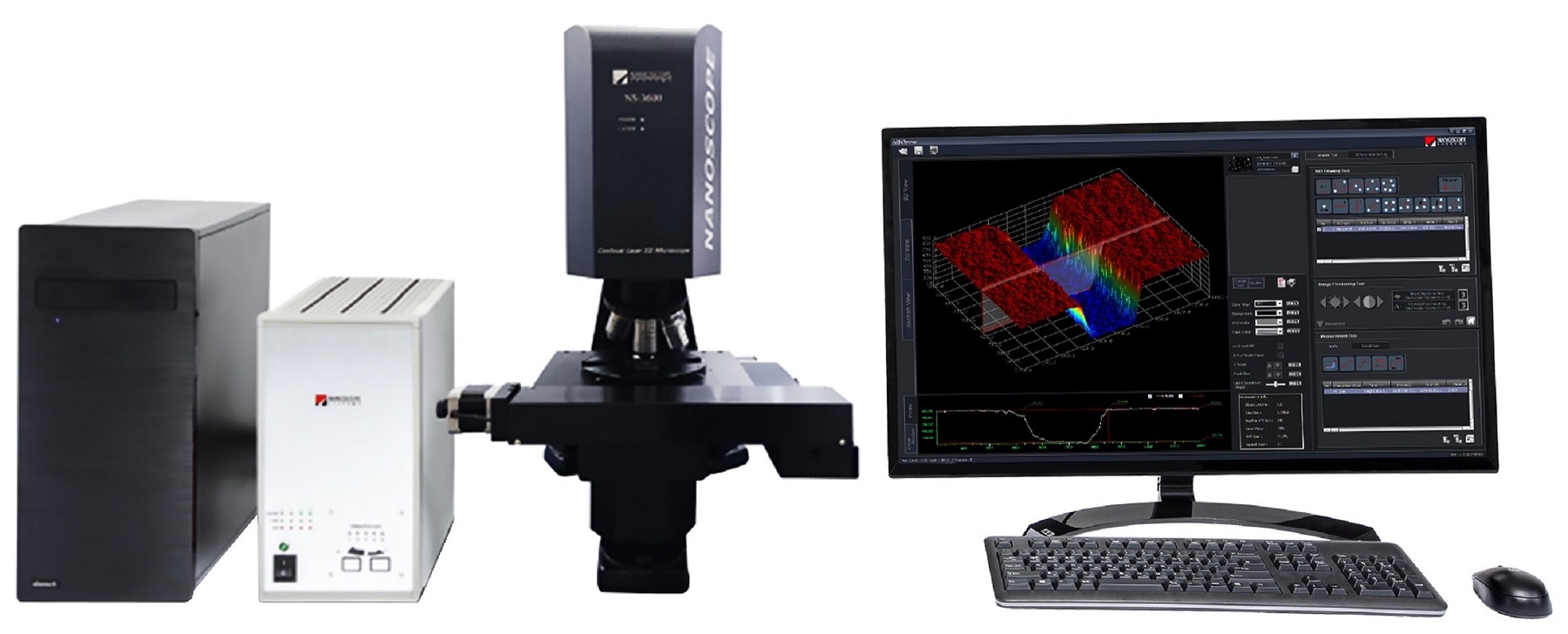
Overview of NS-3500 Technology
The NS-3500 represents a breakthrough in optical metrology. It utilizes the Confocal principle, the most reliable non-contact inspection method available today. Unlike conventional microscopes, the NS-3500 provides sharp 3D images by filtering out-of-focus light, making it ideal for challenging samples like glass, thin films, and semiconductor wafers.
Key Features and Advantages
-
High-Resolution 3D Metrology: Accurate, non-destructive measurement of micro-structures.
-
Real-time Confocal Imaging: Instant visual feedback with rapid focusing capabilities.
-
Surface Roughness Analysis: Automated measurement of optical roughness parameters (ISO compliant).
-
Dual Observation Mode: Simultaneous viewing of 2D microscopic images and 3D confocal data.
-
Auto Tilt Correction: Advanced algorithms to compensate for sample misalignment.
-
Large Area Stitching (NSMosaic): Automatically scan and combine multiple high-magnification images into a single wide-field 3D map.
-
Zero Sample Preparation: No coating or vacuum required, saving time compared to SEM or AFM.
Technical Specifications
| Feature | Specification |
|---|---|
| Laser Source | Laser Diode (Standard 405nm) |
| Z-axis Resolution | Display resolution up to 1nm |
| Scanning System | High-speed Galvano Scanner |
| Stage Type | Motorized XY Stage (Options: 50mm, 100mm, 150mm) |
| Objective Lenses | 5x to 100x (High NA Confocal Objectives) |
| Software Suite | NSWorks (Operation), NSViewer (Analysis), NSMosaic (Stitching) |
Industrial Applications
-
Semiconductor: IC pattern measurement, Bump height, Wire loop inspection, and CMP process analysis.
-
FPD (Flat Panel Display): Touch panel inspection, ITO pattern measurement, and LCD column spacer height.
-
MEMS Devices: 3D profiling of micro-electro-mechanical systems and surface roughness inspection.
-
Materials Science: Tool surface inspection, crack analysis, and solar cell texture measurement.
Frequently Asked Questions (FAQ)
-
Can the NS-3500 measure transparent materials?
Yes. The confocal optical system effectively filters internal reflections, allowing precise 3D reconstruction of glass, polymers, and transparent films.
-
How does NS-3500 differ from an AFM?
While AFM uses a physical probe (contact), the NS-3500 uses a Laser (non-contact). This allows for much faster scanning speeds and eliminates the risk of damaging sensitive samples.
-
Is sample coating required?
No. Unlike SEM, the NS-3500 does not require gold coating or a vacuum environment. You can measure samples in their natural state.
Related Video / Webinar
- Webinar: -
- Video: -